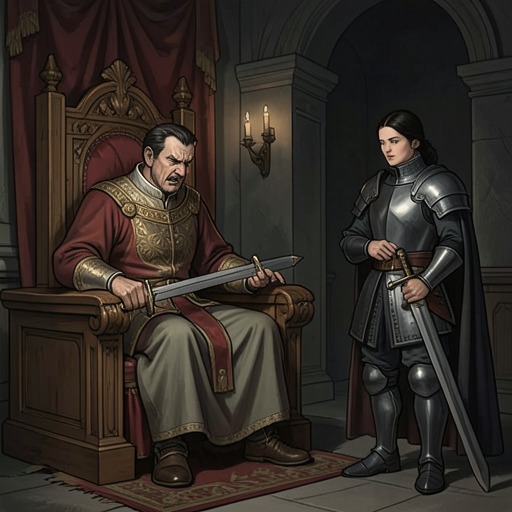
King Mark of Cornwall
Le Morte d'ArthurKing Mark of Cornwall is a ruler of Cornwall whose relations with Ireland, his nephew Sir Tristram, and his brother Sir Boudwin show how quickly lordship and kinship can become instruments of rivalry. He receives Tristram after the young knight returns from Ireland, but their shared love for a married lady brings affection into conflict with jealousy; elsewhere, Mark’s refusal to pay tribute and his treacherous killing of Boudwin expose the violence beneath his political authority.
Identity and Rule
King Mark rules Cornwall, a realm whose political obligations extend beyond its own court. Cornwall has for many years paid tribute to King Anguish of Ireland, but when Anguish’s messenger demands the overdue payments, Mark and his barons answer that they will not pay. Mark’s response does not simply deny the debt: he challenges Ireland to send a knight to fight for its claim, promising that Cornwall will provide a defender of its own. The refusal turns a fiscal dispute into a proposed trial of arms, placing the kingdom’s claim to independence in the hands of combatants.
Tristram at Mark’s Court
Mark is the uncle of Sir Tristram, who returns to Cornwall after surviving his wounds in Ireland. Tristram first goes to Tintagil, where news of his safe arrival pleases Mark and the barons. He then visits his father, King Meliodas, and receives generous gifts of land and goods from his parents. With Meliodas’s permission, Tristram returns to Mark’s court and lives there in prosperity for a long time. This welcome establishes a bond of family and service, but it does not secure lasting harmony between the two men.
The relationship changes when Mark and Tristram both love the same lady, who is the wife of Sir Segwarides. The lady loves Tristram, and Tristram loves her; the account identifies this shared attachment as the cause of jealousy and unkindness between uncle and nephew. Mark’s court thus becomes a place where a family bond and a political relationship are unsettled by rivalry over the same person. The source also describes an earlier chapter in which Tristram brings Queen Isoud home and Mark and Tristram debate, showing that their disputes are not confined to the later attachment.
A further chapter heading records Mark’s journey into England with two knights, prompted by spite against Tristram, and his killing of one of those knights. The heading establishes the hostile action and its connection to his resentment, though it does not supply the episode’s fuller circumstances. It belongs to the same deteriorating pattern in which Mark’s conflict with Tristram extends beyond courtly disagreement into lethal violence.
Tribute, Defiance, and Rivalry
The tribute dispute begins with a clear account of Cornwall’s arrears: Mark has fallen seven years behind in payments to Ireland. When the Irish messenger delivers Anguish’s demand, Mark and his barons reject payment and direct him to tell the king to send a trusted knight to fight for his right. Mark’s answer makes the dispute a contest over who can enforce authority, rather than a negotiated settlement. The decision also exposes Cornwall to the consequences of refusing a claim it had previously recognized.
The narrative places this defiance beside Tristram’s willingness to serve Mark. A messenger arrives with love letters and a small dog from the daughter of King Faramon of France, but Tristram does not return her affection; she dies of sorrow, according to the account. Tristram then rides to his uncle. Learning that no knight will fight Sir Marhaus over the Irish claim, he offers to undertake the combat, asking Mark to grant him the order of knighthood. The evidence presents the offer as an act of service to Mark and Cornwall, in sharp contrast to the later jealousy that divides the two relatives.
Boudwin and the Cost of Treachery
Sir Boudwin, Mark’s brother, is described as a good prince whom the people of Cornwall greatly love. When Saracens land in the country after the departure of the Sessoynes, Boudwin secretly and swiftly raises the local forces. Before daylight, he sets fire to three of his own ships and has them driven by the wind among the enemy fleet. The ships ignite the Saracen vessels; at daybreak Boudwin and his company attack, and the narrative says that they kill forty thousand, leaving none alive. These details establish the scale of the service for which Mark later betrays him.
A chapter heading states the reversal with stark directness: Mark kills Boudwin treacherously despite the good service Boudwin has rendered. The passage supplied for Boudwin’s campaign ends just as Mark learns of his brother’s success, so it does not give the circumstances or motive of the killing beyond its betrayal and its contrast with Boudwin’s service. Taken together, the episodes make brotherhood no safeguard against Mark’s exercise of power: the prince who defends Cornwall and wins popular affection becomes the victim of the ruler he has served.
Narrative Role and Legacy
The account presents Mark through a recurring opposition between obligation and self-interest. He refuses a seven-year tribute and challenges Ireland to justify its claim by combat, while accepting the service of Tristram when Cornwall lacks a willing champion. Yet the kinship that should bind Mark to Tristram gives way to jealousy, and Boudwin’s conspicuous service does not protect him from his brother’s treachery. These episodes frame Mark not simply as a political opponent or a jealous uncle, but as a ruler whose authority repeatedly fails to preserve loyalty within his own family and realm.
His story also unfolds through different kinds of evidence. Some passages narrate events in detail, including Tristram’s return and Boudwin’s defense of Cornwall; others appear as chapter headings that summarize disputes or announce treacherous acts. In both forms, the repeated pattern is legible: Mark’s decisions turn claims of service, tribute, and family connection into occasions for conflict. The consequences fall on the people expected to sustain his rule, from the knight who defends Cornwall to the brother whose success ought to have strengthened it.